
From outreach to follow-up: A better BR&E workflow

Most business engagement breakdowns do not happen because a team is not working hard enough. They happen because the BR&E workflow is broken.
A visit gets logged in someone’s notes. A follow-up sits in an inbox. A key business update never makes it into the database. A new inquiry comes in through the website, but the handoff is manual and inconsistent. When leadership asks for a report, the team has to pull it together from multiple places.
That is still how a lot of economic development organizations operate.
Bludot is built to fix that. As a CRM designed specifically for economic development and BR&E work, Bludot gives teams one place to manage outreach, business visits, assistance requests, follow-ups, projects, and reporting. Instead of piecing together business engagement across disconnected tools, teams can run a more organized, more measurable process from start to finish.
The real challenge is not outreach. It is disorganization
Most teams already know they need to stay close to local businesses. The issue is not intent. The issue is execution.
Spreadsheets get messy. Emails get lost. Notes are scattered. Context lives with one staff member instead of the organization. And when turnover happens, critical business history often disappears with it.
That creates real operational problems. Teams struggle to prioritize who to engage, keep records up to date, stay on top of follow-ups, and show impact in a way that is easy to report internally.
Bludot solves that by centralizing the work. Business profiles, contacts, outreach history, project stages, tasks, survey responses, and reporting all live in one system. That structure gives BR&E teams a much clearer way to manage day-to-day engagement without relying on memory or manual workarounds.

Start with the right businesses, not a static list
A better business engagement flow starts with better targeting.
In BR&E work, every outreach effort should tie back to a goal. Maybe the focus is downtown businesses. Maybe it is a certain industry cluster. Maybe it is firms over a certain size, businesses in a BID district, or companies that opened recently and need early support.
Bludot makes that easier by allowing teams to segment businesses based on the data already in the system. That can include location, employee count, NAICS code, date opened, area of town, demographics, or other custom criteria your team uses.
That matters because a generic list is not a strategy. A focused list is. When teams can filter and segment with purpose, they can spend more time engaging the right businesses and less time sorting through outdated or overly broad data.

Make every business visit count twice
Business visits are one of the most valuable parts of BR&E work, but they often create a familiar problem. Teams collect useful information in the field, then have to remember to update the database later.
That second step is where things often break down.
Bludot helps close that gap by making the visit itself part of the update process. Teams can log activity notes, capture key takeaways, add contacts, assign next steps, and update business profile fields within the same workflow. If a business shares a new contact, updated employee count, square footage, or growth need, that information can be mapped to update the profile automatically.
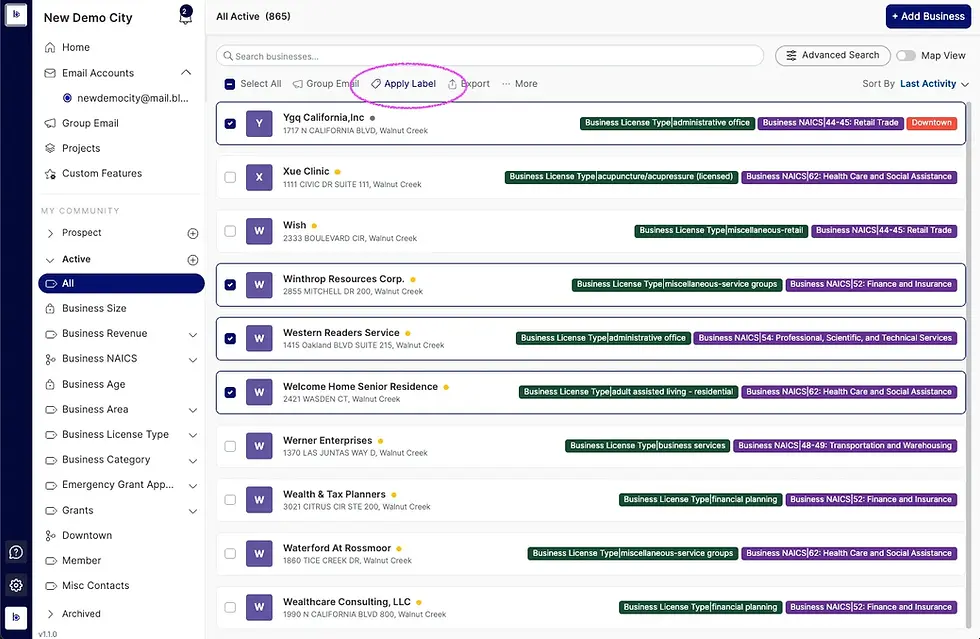
That is a meaningful advantage for BR&E teams. It reduces duplicate work, keeps data fresher, and makes each engagement more useful over time. Instead of creating another note that gets buried, the visit actively strengthens the quality of the business record.
Follow-up should be built into the BR&E workflow
A lot of business engagement falls apart after the conversation.
A concern comes up during a visit. A business asks for help. A next step is clear in the moment, but it never gets assigned, scheduled, or revisited. Not because the team does not care, but because the process depends too heavily on personal memory.
Bludot helps teams build follow-up directly into the engagement flow. Staff can assign tasks, set reminders, create deadlines, and tie those next steps back to the business or project record. That gives everyone a clearer picture of what is outstanding and who owns it.
For BR&E teams managing dozens or hundreds of business relationships, that kind of structure matters. It turns good intentions into a repeatable process and helps prevent important requests from falling through the cracks.
Give businesses a cleaner path to ask for help
Not every engagement starts with staff outreach. Some of the most important opportunities begin when a business reaches out first.
That is why intake matters.
With Bludot, cities and economic development organizations can use survey and intake forms on their website to collect assistance requests, new business inquiries, or development opportunities in a more structured way. Instead of routing everything through a general email inbox, the form can collect the right details upfront, including business name, contact information, request type, and preferred follow-up timing.
More importantly, Bludot can turn that submission into action automatically. A form response can create a prospect, create a project, assign tasks, and set an initial status based on the workflow your team already uses.
That helps teams respond faster, standardize intake, and create more consistency across staff. It also creates a much stronger operational foundation than manually triaging requests one by one.

Track the full lifecycle, not just the first interaction
Business engagement does not stop after one visit or one inquiry. A business assistance request can turn into a longer-term project. A prospect can move through stages. An attraction lead might involve meetings, site visits, follow-ups, and eventual ribbon cutting.
Bludot supports that longer lifecycle by helping teams manage projects by type, phase, and status from the beginning. That means teams can track not just activity, but progress.
How many projects are in intake right now? How many are in progress? How many tasks are outstanding? How many new development opportunities are active? How many business requests have moved beyond the first stage?
Those are the kinds of questions leadership often asks, and they are much easier to answer when the workflow is already structured inside the CRM.
Reporting gets easier when the work is already organized
Reporting is one of the biggest pressure points for economic development teams. Leadership wants visibility. Councils and boards want evidence of activity and outcomes. Staff need to show what has happened over the last quarter, the last 90 days, or across a specific initiative.
If outreach is fragmented, reporting becomes a scramble.
Bludot makes reporting easier because the work is already captured in the system. Teams can filter and export business visits, project activity, follow-ups, statuses, and other engagement data without rebuilding everything manually. Whether the need is a quarterly BR&E update, a district-specific outreach report, or a snapshot of active development projects, the reporting process becomes much more manageable.
That is one of the clearest reasons Bludot stands out as a CRM for economic development. It is not just a place to store contacts. It is a system built around the actual workflows public-sector teams need to run and explain.

Why Bludot stands out for BR&E
BR&E teams do not need a generic sales CRM. They need a platform that reflects how economic development work actually happens.
That is where Bludot is different. It is purpose-built for business retention, expansion, attraction, outreach, projects, surveys, and reporting. It helps teams organize business engagement in a way that is practical, scalable, and much easier to manage internally.
For organizations still relying on disconnected tools, that shift can be significant. Better targeting. Better follow-up. Better data. Better reporting. And a much stronger foundation for the work itself.
If your team is looking for a better way to manage business visits, assistance requests, and project-based engagement, Bludot gives you the structure to do it well. Schedule a demo and inquire about a free trial.


